How to Identify Japanese Knotweed: A Photo Guide by Season
TL;DR — Japanese knotweed changes appearance with the seasons: purple-tipped asparagus-like shoots in spring, tall green canes with shield-shaped leaves and creamy flower spikes in summer, yellowing foliage in autumn and brittle brown canes in winter. It is not illegal to have it on your land, but digging, strimming or moving soil can spread it and make treatment far more expensive. If you think you have found it, photograph it, note the location, and book a professional knotweed survey before you touch it.
Japanese knotweed is the plant West Wales property owners most dread finding. It grows fast, it is genuinely hard to kill, and it can complicate a mortgage, a sale or an extension plan. The good news: Japanese knotweed identification is straightforward once you know what to look for in each season — and catching it early, before it establishes, makes management much simpler and cheaper.
This guide gives you a photo-based checklist for every season, the lookalikes that cause false alarms, and exactly what to do (and not do) if you find a suspect plant on your land.
Identification-first · Serving Ceredigion, Carmarthenshire, Pembrokeshire and Powys.
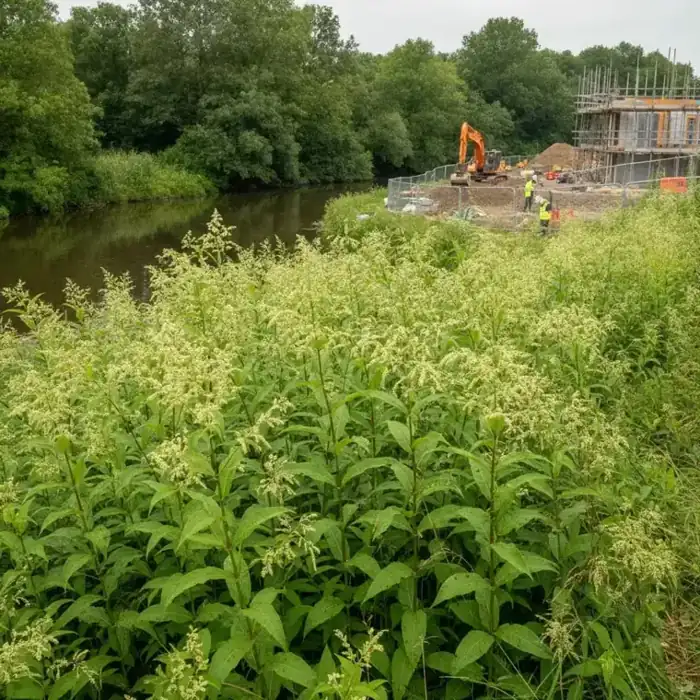
Why West Wales properties need to know this
Japanese knotweed loves the conditions we have here. It spreads fastest along watercourses and damp ground, and it was historically planted along railways, on old tips and around Victorian properties before anyone understood the damage it causes. That describes a lot of the Ceredigion and Carmarthenshire landscape: river corridors such as the Teifi, the Aeron and the Rheidol, the old railway lines around Aberystwyth, Cardigan and Lampeter, and damp ground near the coast at New Quay, Aberaeron and Llanelli.
If your property borders a river, a stream, a railway line or an old building site, it is worth checking your boundaries once a year — particularly in late spring and early summer, when the plant is easiest to spot. Knotweed does not respect fence lines, and the plant causing a problem on your land may have started several gardens away.
The wetter, milder the winter, the earlier spring shoots appear — so treat the months below as a guide, not a calendar.
Spring identification (March–May): the shoots
Spring is the best time to catch knotweed early, because the shoots are distinctive before anything else in the garden has got going.
Look for:
- Asparagus-like spears pushing up through the soil, often in dense clusters.
- Reddish-purple colouration on the tips and stems of young shoots.
- Shoots that push through cracks in tarmac, paving, decking gaps and around drains — knotweed can force its way through small gaps.
- Leaves on young plants are small, dark and rolled or curled at first, unfurling as the shoot grows.
A clump of knotweed in April looks tender and almost ornamental. It is not. A stand that reaches ankle height in April can be above head height by July.
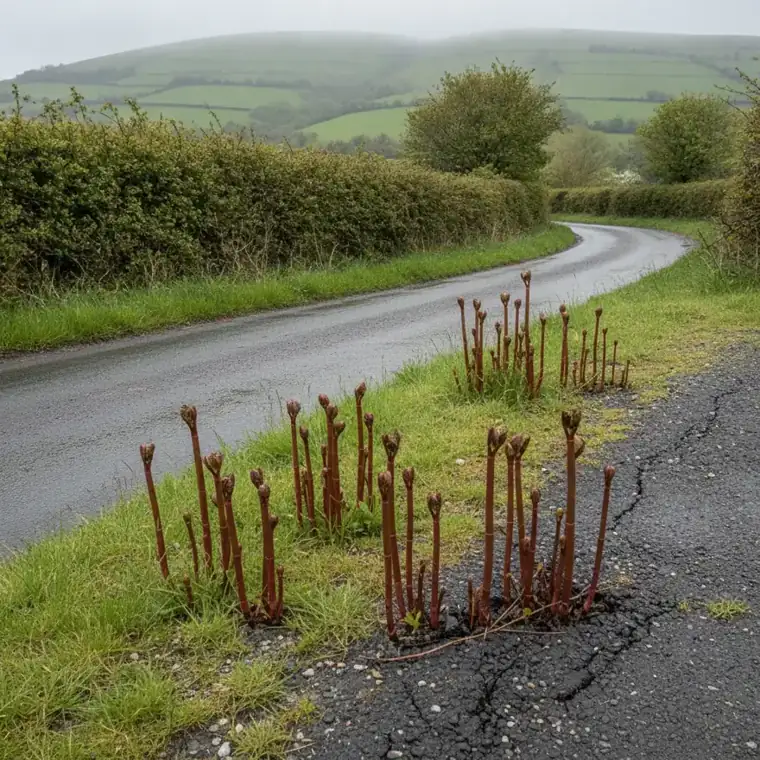
If you find shoots like these, book a knotweed survey — spring is the cheapest time to deal with it.
Summer identification (June–August): the mature stand
Summer is when identification is easiest, because the mature plant has several features that are very hard to mistake once you know them.
Look for:
- Tall, upright canes — typically 2 to 3 metres high by late summer, dense and bamboo-like, but the stems are softer than bamboo and noticeably zigzag between the leaf joints.
- Stems that are green with purple or red flecks, and hollow inside if you snap one.
- Shield- or shovel-shaped leaves: roughly the size of your hand, bright mid-green, with a flat base where the leaf meets the stalk and a pointed tip. They alternate along the stem in a zigzag pattern.
- Creamy-white flower spikes in July and August — frothy tassels around 10 cm long, clustered towards the ends of the stems.
The combination that confirms it: upright hollow canes, shield-shaped leaves in a zigzag, and creamy flower spikes on the same plant. If you have all three in July, you have knotweed.
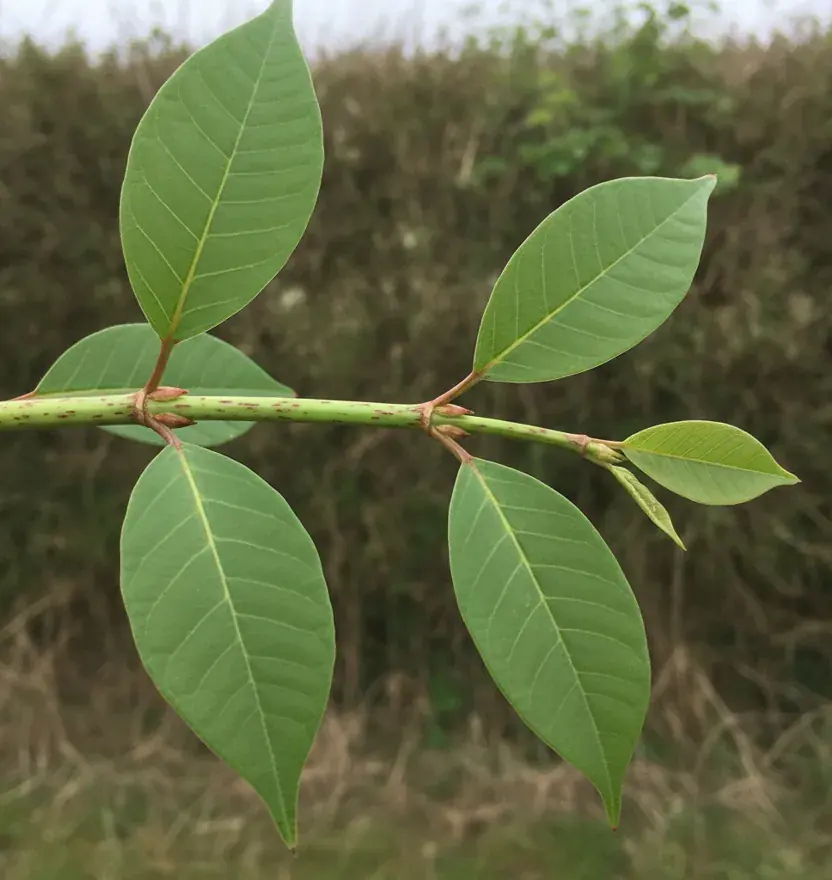
One honest caveat: a photo can strongly suggest knotweed, but a surveyor will check the rhizome (the underground stem) before confirming it. A professional survey is the only way to be certain — and it matters, because treatment for a confirmed stand is very different from dealing with a lookalike.
Autumn and winter identification (September–March): the dying-back canes
Knotweed is a perennial: the top growth dies back each autumn, but the plant is very much alive underground.
Look for:
- Autumn: leaves turning yellow, flowers going brown, the stand collapsing back on itself.
- Winter: dense stands of dead, brittle canes, orange-brown to rust coloured, still upright or collapsed in a tangle. Snap one and it is hollow, like a drinking straw.
- In very wet ground the dead canes may rot down by late winter, leaving little sign above ground — which is exactly when people assume the problem has gone. It has not. The rhizome sits dormant in the soil and will send up new shoots in spring.
Winter is the season of false reassurance. If you see dead canes, mark the spot and check it again in April.
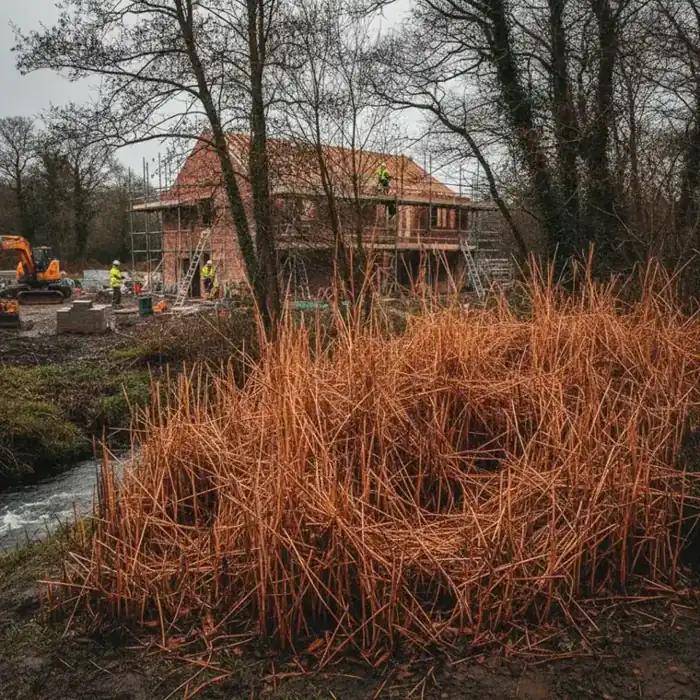
Dead canes on your boundary? Book a survey before the spring growth season.
Plants commonly mistaken for Japanese knotweed
Most “knotweed” scares turn out to be something else. These are the usual suspects:
Hedge bindweed / field bindweed
Similar white flowers, but bindweed is a low twining vine with arrow-shaped leaves, not tall upright canes.
Russian vine (mile-a-minute)
A relative of knotweed and a real climber; it smothers fences with heart-shaped leaves and creamy flowers, but it twines and climbs rather than standing upright and self-supporting.
Himalayan balsam
Also common on West Wales riverbanks, so it often grows alongside knotweed. Taller than it looks (up to around 2 metres) with orchid-like pink-purple flowers and explosive seed pods. It is invasive too, but it is not knotweed and is managed differently.
Bamboo
Real bamboo has hard, woody, persistent stems. Knotweed stems are softer, die back to brown canes in winter, and carry shield-shaped leaves and cream flower spikes.
Broad-leaved dock
Large leaves, but low-growing with no tall canes and no flower spikes.
If you are unsure, take clear photos (whole plant, leaves, stems, flowers if present) and get them looked at by someone who deals with knotweed regularly. Guessing wrong in either direction costs you: unnecessary worry on one side, a spreading infestation on the other.
Where knotweed hides on a property
When you check, look beyond the flower beds. Knotweed favours:
- Boundaries and fence lines, especially where soil has been dumped or moved.
- Riverbanks and stream sides — follow the water’s edge on both sides of the boundary.
- Old rubble and tips — knotweed thrives on disturbed ground with buried rubble.
- Around drains, manholes and inspection chambers, where it exploits gaps.
- Under decking and behind sheds and outbuildings, where it grows unseen until it is large.
The visible stand is only part of the plant. The rhizome underground can extend several metres beyond the canes you can see — which is why a stand on the boundary is very often rooted in the neighbouring plot, and why treatment plans cover an area, not just the visible stems.
What to do next — and what not to do
If you suspect you have Japanese knotweed:
Do not strim, mow, cut or dig it.
Every cut fragment and every shovel of contaminated soil can spread it; rhizome pieces regrow from small fragments, and digging without a plan usually makes the infestation bigger.
Take photographs
— whole stand, close-up of leaves and stems, anything distinctive — and note the date and location.
Get it properly identified.
A survey establishes whether it really is knotweed, how far the rhizome extends, and what treatment route fits the site.
Tell your builder early if you are planning work.
Excavating near an established stand — for foundations, an extension or a driveway — needs knotweed factored into the method and the soil management, not discovered mid-dig.
One thing worth knowing before you involve your mortgage lender: lenders commonly ask for evidence that knotweed on an affected property is being properly managed, and many require an insurance-backed guarantee before they will lend. Treatment and guarantee availability vary from site to site, so if that matters to your sale, remortgage or purchase, ask MGC directly whether an insurance-backed guarantee is available for your job — we will tell you honestly what is and is not possible for your site. Treatment typically combines herbicide application over several growing seasons with excavation where the ground is to be built on; the right route depends on what the survey finds.
MGC handles knotweed identification, management and remediation across Ceredigion, Carmarthenshire and the rest of West Wales. Book a knotweed survey →
Frequently asked questions
Straight answers on the law, selling, damage, DIY treatment and how long treatment takes.
It is not an offence to have knotweed growing on your own land. It is an offence to allow it to spread into the wild — and soil containing knotweed is classed as controlled waste, which must be handled and disposed of by licensed routes. "Digging it out yourself and taking it to the tip" is exactly the sequence that gets people into trouble.
Yes, but you must answer the conveyancing questions about it honestly, and the buyer’s lender will usually want evidence of a treatment plan — often with an insurance-backed guarantee. Unmanaged knotweed is what stalls or kills sales; a documented management plan is what keeps them moving.
It exploits existing weaknesses — cracked drains, gaps in walls, movement joints — and can worsen them, but stories of it growing straight through solid concrete are mostly exaggerated. The bigger risks are financial: treatment cost, and the effect on selling, extending or remortgaging.
Cutting and digging generally make it worse, and herbicide treatment takes several carefully-timed applications over multiple growing seasons to work. For anything larger than a brand-new single shoot, professional management is usually cheaper than the DIY route once you count the regrowth.
It varies with the size and age of the stand and what you want to do with the ground afterwards — treatment typically runs over several growing seasons, and sites being built on may need excavation instead of, or as well as, herbicide. A survey gives you a realistic programme for your specific site.
Found something that looks like knotweed? Photograph it, don’t touch it, and book a survey with MGC’s specialist works team. We cover Aberaeron, Aberystwyth, Cardigan, Lampeter, Carmarthen, Llanelli and the rest of West Wales.
Book a knotweed survey.
Identification, management and remediation across West Wales — with honest advice on what is and is not possible for your site.