Self-Build in West Wales: Costs, Planning and How the Process Works
Building your own home in West Wales is more achievable than most people assume — but the gap between a sketch on the back of an envelope and a watertight house is where budgets and nerves go. This guide covers what a self-build in Ceredigion or Carmarthenshire actually costs, how planning works in Wales, and how long to realistically expect it all to take.
Free quotes · No obligation · Based in Aberaeron.
Local to West Wales
Based in Aberaeron and working across Ceredigion, Carmarthenshire, Pembrokeshire and Powys.
Planning handled
We prepare and manage the planning application and building control submissions for you.
Fixed-price design & build
A fixed quotation based on the agreed design — the price is tied to drawings, not guesswork.
What counts as self-build?
Strictly speaking, self-build means you organise the project yourself: you buy a plot, commission the design, hire the builder, and manage the sequence of trades. In practice, most people who say “self-build” actually want something between that and a standard developer purchase — they want control over the design without becoming a part-time project manager for eighteen months.
That middle route is design-and-build: one contractor takes responsibility for design, planning and construction under a single contract. You still make the decisions; you just don’t coordinate the trades, chase the building control inspections or sit in the gap where the electrician blames the plasterer. MGC’s new build service works this way, and the choice between the two routes changes your budget, your timeline and your stress levels more than anything else you decide.
What does it cost to self-build in West Wales?
The honest answer is a range, and anyone who quotes a single figure before seeing your plot and your design is guessing.
For context, Build It magazine’s 2026 self-build cost analysis puts a typical UK self-build at £2,500–£3,000 per m². Checkatrade’s national cost data gives a wider band of £1,775–£3,000 per m², averaging just under £2,400. On those figures, a 150 m² three-to-four-bedroom house comes out roughly between £265,000 and £450,000 for the build itself — before the plot, professional fees, connection charges and contingency.
Those are national figures. What moves you up or down the range in West Wales specifically:
Site and ground conditions
Rural plots around Aberaeron, Lampeter and Newcastle Emlyn often need treatment works, longer access tracks and drainage that a level city infill site wouldn’t. Ground conditions decide foundation cost more than any other single factor.
Shape and complexity
A simple rectangular house with a straightforward roof is far cheaper per m² than the same area spread across an L-shape, multiple gables and dormers.
Specification
Underfloor heating, an air source heat pump, triple glazing and solar PV all add cost up front. If you are adding solar, an MCS-certified installation matters for access to government schemes — it is worth specifying during the build rather than retrofitting.
Coastal exposure
Building on the Cardigan Bay coast, around New Quay, Aberaeron or Aberystwyth, means materials and fixings rated for salt-laden wind, which adds a modest but real premium.
Contingency
The self-build literature is unanimous and so is our experience: hold 10–15% back. If you never spend it, you have a holiday.
Two small mercies on the budget: self-builders can normally reclaim VAT on qualifying materials through HMRC’s DIY housebuilders scheme (VAT Notice 431C), and you are not paying a developer’s margin on the finished house — often the difference between self-build economics working or not.
How long does it take?
Plan in years, not months — and distrust anyone who tells you otherwise.
Design and planning
Typically 6–12 months before you break ground. A new dwelling in Wales always needs a full planning application — permitted development rights do not cover new houses — and a pre-application conversation with the planning authority is money well spent.
Decision
Local planning authorities in Wales work to statutory decision targets of 8 weeks for minor schemes and 13 weeks for larger ones, but complex or contentious sites take longer.
On site
A typical self-build runs around 10–14 months from breaking ground to completion, weather depending. West Wales weather is a genuine variable — autumn and winter ground conditions around the coast and the Teifi valley can slow foundations and masonry. Welsh weather slips programmes; any builder who promises it won’t is selling you something.
Watertight
The milestone that matters most to anyone renting while they build. Ask any prospective builder not just “how long is the programme?” but “when will it be watertight?” — and get the answer in weeks from the start on site.
Planning in Ceredigion and Carmarthenshire
Your application goes to the local planning authority — Cyngor Ceredigion or Carmarthenshire County Council, depending on the plot — and is decided against the local development plan and national planning policy for Wales. In practice, the things that decide a self-build application in West Wales are ordinary: access and visibility on rural lanes, drainage and sewerage (many rural plots need a package treatment plant), the design’s relationship to local character, and sometimes bat, barn owl or other ecological surveys.
If the plot is in or near a flood-risk area — check Natural Resources Wales flood maps before you fall in love with it — expect drainage strategy to become the centrepiece of the application. Our guide to flood prevention for coastal and river properties explains what that involves.
Is there any help for self-builders in Wales?
Yes. Self Build Wales is a Welsh Government scheme that finds plots with planning permission already in place and supports applicants through to completion, including self-build loans that are only repaid when the house is finished. Applicants can use a scheme plot, their own land or land they have found. The scheme has its own rules — including TrustMark registration for participating builders — so read the small print early, but it removes the single hardest part of self-building in Wales: finding a plot that will actually get permission.
One difference from England matters: Wales has no statutory “right to build” register system, so do not rely on the English self-build legislation you may have read about — plot-finding in Wales runs through schemes like the above, local knowledge and patience.
How MGC runs a design-and-build new home
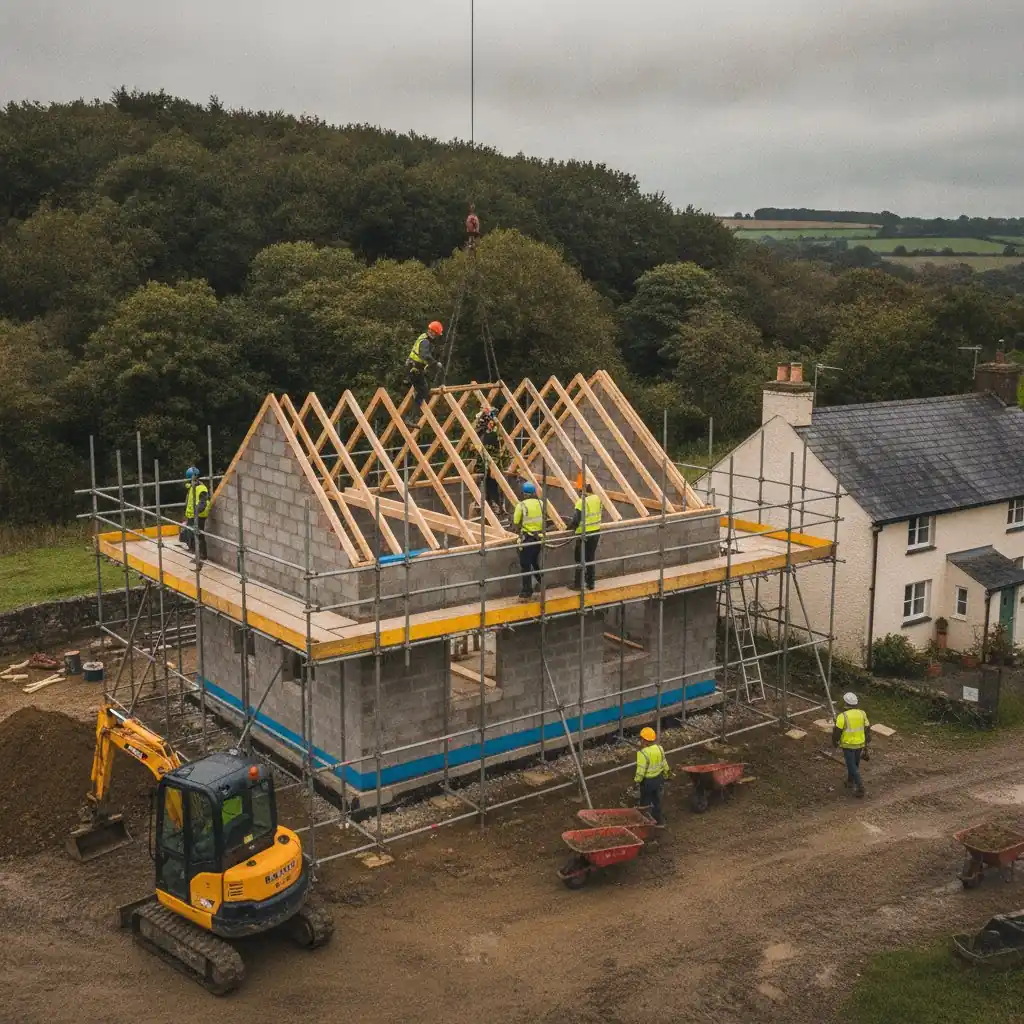
Whether or not you use the Self Build Wales scheme, most clients choose design-and-build over pure self-management for one reason: accountability.
Survey and design
We survey the plot and design the house with you, with a fixed quotation based on the design — so the price you agree is tied to drawings, not guesswork.
Planning and building control
We prepare and manage the planning application and building control submissions. You sign forms; we do the paperwork.
Our own trades build
Our own trades build the house. No stitching together separate trades and no gaps between them where problems live.
One point of contact
You have one point of contact from first sketch to handover.
If you are weighing up builders for any project, our guide to choosing a builder in West Wales covers the questions that separate the professionals from the rest — and the rear extension guide is worth a read too, because extending an existing house is the most common project we price alongside self-builds.
Design, planning and construction under a single contract.
Frequently asked questions
Straight answers on cost, planning, timelines and getting help with plot-finding in Wales.
As a working figure, £1,775–£3,000 per m² depending on specification and site conditions — so a 150 m² house is roughly £265,000–£450,000 for the build, before the plot, fees and contingency. Ground conditions, complexity, coastal exposure and your specification move you within that range.
Yes — every new dwelling in Wales needs a full planning application; permitted development rights do not apply to new houses. Budget 6–12 months for design and the application before work starts on site.
Typically 18–24 months end to end: 6–12 months of design and planning, then 10–14 months on site, weather depending. Ask any builder when the house will be watertight, in weeks from starting on site — that is the number that governs your life while you build.
The Welsh Government’s Self Build Wales scheme lists plots with planning permission in place and provides finance repaid on completion. Alternatively, plots come up through local agents, auction and word of mouth — but check planning prospects, access and flood risk before buying.
Sometimes slightly on paper, often cheaper in reality. A self-manager avoids a main contractor’s overheads and margin, but routinely underestimates the cost of their own time, waste from poor sequencing, and the premium trades charge for one-off, unplanned work. Get both routes priced before deciding.
Ready to talk about your plot?
If you have a plot in mind — or just an idea and a postcode — tell us the basics and we will tell you honestly what it involves.
Use the enquiry form (name, contact, postcode and what you are planning) — we aim to reply within one working day.
Serving Ceredigion, Carmarthenshire, Pembrokeshire and Powys — from our base in Aberaeron.
Let’s talk about your self-build.
Free, no-obligation quotes on new builds anywhere in West Wales.